Showing posts with label Transport for Greater Manchester. Show all posts

Tuesday, 27 May 2014

How fast can your granny run?

In April, the BBC reported that Manchester had become the UK's first city to be recognised as age-friendly by the World Health Organisation. More accurately, Manchester has become the first UK city to become a member of the WHO Global Network of Age-friendly Cities and Communities (GNAFCC).

As a network member, Manchester has committed to “undertake a process of continually assessing and improving their age-friendliness” and will ensure that “older residents are involved in a meaningful way throughout the process.”

If Manchester is serious about becoming age-friendly as well as improving the walkability of the City then one practical measure that the Council, and the other GM local authorities, could implement is to change the crossing times at pedestrian crossings.

How fast can YOUR granny run?

Research for Living Streets found that most people over the age of 65 walk much slower than the current assumed walking speed of 1.2 metres per second, on which the “green man” time allowed to cross is based, meaning they have insufficient time to safely reach the opposite kerb.

Or, put another way, the “green man” crossing time is not enough for 85% of women and 76% of men aged 65 and over.

The current crossing time guidance dates from the 1950s when levels of car ownership and traffic were much less than today. Living Streets is calling for the assumed walking speed to be changed to 0.8m/s which would add just 3 more seconds onto the green man crossing time on an average width road.

  • 3 seconds might not sound like much, but for older people, people with mobility issues and parents with children it can really have a big impact.
  • 3 more seconds could help make Manchester a better place to walk. Increasing the number of people walking might encourage more people to leave the car at home for shorter trips to their local shops and neighbourhoods. Making Manchester a nicer place to walk would also be fairer to the 45% of Manchester households who do not own (or have access to) a car. (Census 2011)

Increasing walking levels and reducing car traffic volumes (and speeds) could also encourage more people to cycle – you never know we might catch up with the Dutch where people over 65 make 24% of all their trips by bicycle.(Page 504)

You can find out more information and support the Living Streets “Give me time to cross” campaign on the website.


PS Shortly after this blog article was first drafted, the Manchester Evening News reported that the Government was reviewing road-crossing times. The article quoted Transport for Greater Manchester as saying: 

“At signalised junctions with pedestrian facilities, Greater Manchester follows the standard Department for Transport guidance of 1.2 metres per second walking speed.
“If a longer crossing time is required we do review this on an individual basis along with local authority engineers.

“We’re aware of this ministerial proposal and will follow developments with interest. If the guidance from the Department for Transport changed to assume a lower speed then we would change all our crossing speeds accordingly.”

Stay tuned to see what comes of this review.

Friday, 7 March 2014

No, protected cycling infrastructure is probably not too expensive for your city to build....


Here in Greater Manchester, the successful "Vélocity 2025 : A cycling plan for 2025 and beyond" bid for Cycling City Ambition Grant (CCAG) funding committed the conurbation to providing total funding over a 12 year period that would see "between £150 and £200 million invested on a range of cycling infrastructure, interventions and culture shift of which £20 million will be from the Cycle City Ambition Grant, £20 million from the LSTF and the remainder from a range of local and national, public and private sources through to 2025."


The current CCAG funding runs until March 2015 and as yet, neither the Greater Manchester Combined Authority (GMCA) or Transport for Greater Manchester (TfGM) have publicly identified where the next 10 years of funding will come from, or how much funding will be provided.  

The current CCAG funding level is £10 per person but only covers 1 million people - so on a GM wide basis this translates as £3.70 per person.  The All Party Parliamentary Cycling Group report "Get Britain Cycling" recommended that national / local government should support cycling with funding levels of £10 per person - across the whole of Greater Manchester this would work out at £27 million per year.  


One of the many argument(s) that will no doubt be made against providing funding for cycle infrastructure will be "but it will cost too much".  To put these arguments into context it is worth taking a look at a recent report by the San Francisco Bicycle Coalition which is a "brief exploration" of what they called the "myth" that "there's no way we can keep spending so much on bike lanes with so many other pressing needs in San Francisco."

To make their point that dramatically improving biking and walking in a city costs almost nothing compared to many other transportation projects — in San Francisco, one of the bike-friendliest cities in the country, bike projects take up less than 1 percent of the municipal transportation budget — they listed some typical cost figures.  The lovely people at the Green Lane Project  created the chart below from those figures.

Future blog posts will return to this theme and explore the arguments and evidence of the economic benefits of increasing cycling levels - as well as the lobbying arguments that will be needed throughout the coming year(s) to secure the funding needed to build a safe, convenient and coherent cycle network across Greater Manchester. (Note: the budget discussions for 2015-16 will start in October this year)

Meanwhile, enjoy the graphic. Click here for the original graphic.


Tuesday, 19 November 2013

Question time: What would you like to ask Baroness Kramer (the new Transport Minister) ?


Somehow, I find myself invited to the Mainstreaming Smarter Travel event on 3rd / 4th December in Manchester Town Hall. This is described in the publicity as an "annual event where representatives and stakeholders from all Local Sustainable Travel Fund (LSTF) awarded regions come together to share knowledge, good practice and discuss effective implementation of projects."
(Programme details available here)

One of the sessions on Wednesday 4th December, there will be what is describde as "an extended interview and discussion with the new Transport Minister with responsibility for LSTF, Baroness Susan Kramer, Cllr. Andrew Fender, Chair of TfGMC and Mike Blackburn, Chair of Greater Manchester LEP and BT regional director for the North West."

I have received an email asking me what my top questions would be for the three interviewees (see below).  Deadline is 12noon, Friday 22nd November.  So if you have any burning questions you would liked asked - why not send them in to the email address below or leave a comment on this blog.


A message from Lynn Sloman, Director of Transport for Quality of Life, Plenary Chair for Mainstreaming Smarter Travel Day 2

On the second day of the Mainstreaming Smarter Travel conference, there will be an extended interview and discussion with the new Transport Minister with responsibility for LSTF, Baroness Susan Kramer, Cllr. Andrew Fender, Chair of TfGMC and Mike Blackburn, Chair of Greater Manchester LEP and BT regional director for the North West.

I’d like to know your top questions for our three interviewees. We’ll endeavour to cover as many of them as possible – and certainly to address all the most popular topics.

Baroness Kramer was famed for her indefatigable pavement-pounding when she was the Lib Dem candidate for the London mayoral election in 2000, pledging to walk every high street in the capital city. So you might want to ask her what options she sees from her Ministerial hot seat to boost active travel. Or you might want to know what ideas Mike Blackburn and his fellow LEP Chairs have got for capital investment in sustainable travel post-2015.

Please send your questions by 12pm FRIDAY 22nd NOVEMBER to rory.mcmullan@landor.co.uk.
Mark your email ‘LSTF Question Time’.


Thursday, 22 August 2013

Greater Manchester Road Safety Summit (17th September 2013)


Dr Jon Lamonte, Chief Executive of Transport for Greater Manchester, personally invites you to the first Greater Manchester Road Safety Summit - Drive for Momentum.

The summit will provide key decision makers with information about initiatives and progress to date; an overview of future opportunities; and hold a workshop on a future local road safety strategy.

Your influence will be vital in shaping the future direction of road safety and casualty reduction interventions in Greater Manchester.

The programme will include:
  • National policy, local progress and initiatives
  • Future measures
  • Partnership working and overcoming funding challenges
  • Protecting Vulnerable Road Users (Pedestrians, Cyclists, Motorcyclists and Young Drivers)
  • The role of the emergency services
  • GM Road Safety Strategy Workshop
  • Mini-exhibition
Register via roadsafety@tfgm.com or phone 0161 244 1721

(PS.  Perhaps someone would like to suggest a better title than "Drive for Momentum")

Tuesday, 30 April 2013

Vélocity 2025 - A cycling plan for 2025 and beyond... Greater Manchester bids for £20 million

Our new network for cycling across Greater
Manchester will connect all 2.7 million
residents with high-quality cycling routes,
segregated wherever possible, that will
connect across the city region in a wellsigned
and easy to use European-style network.
Today (30th April) was the deadline for all the cities bidding for the Cycling City Ambition Grant funding. 

The Velocity 2025 programme outlines the targets - which include:

"The outcome of our Vélocity 2025 programme – our target – is to secure at least a 300% increase in the levels of cycling across Greater Manchester by 2025.

We want to see the proportion of trips by bicycle increase to 10% over the next 12 years, which we believe is achievable alongside additional Government funding. We aim to double, and double again the proportion of trips made by bicycle, whether that’s commuting, utility or recreational cycling, through an unprecedented, long range  programme of investment in cycling infrastructure for the city. 


The vision we set out for Vélocity 2025 supports the targets in the All Party Parliamentary Cycling Group ‘Get Britain Cycling’. The CCAG funding, supported by local funding, will help us,
by 2015:


  • Deliver 56km of largely segregated cycle route across Greater Manchester 
  • Generate 26,800 new cycle trips per day on these routes 
  • Improve the health and wellbeing to the value of £7.3m per year
  • Provide business financial savings by reducing absenteeism of 1,000 days per year 
  • Remove 1.7m traffic kms per year from Greater Manchester’s roads reducing congestion and accidents.
The Velocity  video is available below:


The bid document explains that: "Greater Manchester is bidding for the funding needed to deliver a generational shift in levels of cycling across the city region. The catalyst we seek is £20 million and if we are successful, this grant will unlock up to ten times that amount over the next decade or so as the city region delivers a remarkable strategic programme of change.
 

Central government funding will be matched by £10 million from Greater Manchester partners by 2015.  The Cycle City Ambition Grant (CCAG) will deliver £10 per capita investment per year for two years across the core of the city region (one million residents). 

Greater Manchester will then seek to commit future funding, through public and private sector sources, for a further ten years (giving a consistent twelve year programme) and across the rest of Greater Manchester (a further 1.7 million residents).

In total our Vélocity 2025 programme would see between £150 and £200 million invested on a range of cycling infrastructure, interventions and culture shift of which £20 million will be from the Cycle City Ambition Grant, £20 million from the LSTF and the remainder from a range of local and national, public and private sources through to 2025."


The Greater Manchester bid is supported by Love Your Bike and other Greater Manchester cyclign groups.  You can show your support (assuming you do) on the Love Your Bike petition on Change.org.


Friday, 8 February 2013

Free cycle parking stands from TfL and TfGM (reportedly!)


If we want people to integrate cycling into their everyday activities there are some clear changes that we need to make.  Top priorities include creating safe, continuous, high quality cycle routes that go to destinations that people want to travel to; re-allocating roadspace to encourage people to walk and cycle more and reducing traffic speeds in residential areas   (20s Plenty).

In addition we also need to ensure that they have somewhere secure to park/store their bicycles where they live, work and in the public realm. If people do not have anywhere to safely store or lock their bicycles - why would they cycle.

Recently came across an interesting Transport for London (TfL) scheme that provides "free" cycle parking stands for businesses in London.  There are a number of conditions that the company needs to sign up to and these include: 
  • Your organisation must have a minimum of five employees at the location.
  • The number of stands available (up to 20) depends on the number of employees at the location, and is at our discretion
  • Stands must be installed on privately owned land. The land owner must have given permission and any planning regulations must be followed
  • Your organisation must sign up to the "Businesscycle" scheme
  • Your organisation can choose from three designs: Sheffield, toast racks and vertical
  • Your organisation has to pay for installation and ongoing maintenance
  • Your organisation must agree to send us photographic evidence of installation within three months of delivery
  • Your organisation must not have an undischarged planning obligation or Section 106 agreement for cycle parking relating to the site

These conditions seem reasonable and companies can (depending on number of employees) order up to 20 stands. 

It will be interesting to see how effective this scheme is at encouraging businesses to install more cycle parking.


So what is on offer in Greater Manchester?  It is reported that Transport for Greater Manchester is offering businesses grants for "cycling facilities" but unless you already knew this the TfGM website is a little opaque.


The Grants paragraph states that:
"As part of the LSTF Project Transport for Greater Manchester can provide grants and match funding towards the cost of providing cycling facilities at your workplace. Organisations receiving financial assistance will be required to commit to furthering cycling at their workplace by nominating a member of staff to act in a cycle liaison role as well as taking part in other relevant activities."

Which is all good.... but would be even better if some more specific details were available.  Just a thought !

Any companies wanting more details of the TfGM grant assistance should contact the cycling team at cycling@tfgm.com 


Monday, 4 February 2013

Bikes are allowed on ALL Metrolink train cars..... (but unfortunately not here !)

Bikes are allowed on ALL Metrolink train cars.... How great that statement would be if it applied to the Metrolink service in Greater Manchester.

Unfortunately, the "Bike on Board. The New Way to Commute" promotion is for the Metrolink services in Southern California, USA. The public transit provider has added Bike Cars to accommodate more bikes on select trains as part of Metrolink's green initiatives program.

According to the guidelines the lower levels of the new Bike Cars are equipped with stalls that are designed to hold three bikes each. Bike Cars are identified by a yellow “Bike Car” decal on the side of the train or bike train wrap. Each train car is designed to hold three bikes.  The special Bike Cars are designed to hold 18 bikes on the lower level.

Contrast the progressive US policy with the current Metrolink guidance on the Transport for Greater Manchester (TfGM) website.


Despite ongoing campaigning, Transport for Greater Manchester (TfGM) remains ambivalent (at best) and hostile (at worst) to integrating cycle carriage into the public transport network. Previous blog posts provide some of the detail of earlier (unsuccessful) lobbying campaigns.


So far, Greater Manchester's politicians and transport planners have demonstrated a striking lack of imagination with regards to integrating bicycles and public transport.  TfGM Committee members (local councillors) and officers really do need to catch up with the growing number of European and North American cities who have successfully promoted the (less than revolutionary concept) of enabling people to travel with their bicycles and not just providing bike parking at bus, tram or train stations. What are people supposed to do when they get to their final stop or station and still have one (or more) miles to travel to their final destination ?  Combining bikes and public transport is a really effective solution to the "problem of the last mile."

Other cities are leading the way...... Manchester needs to catch up, fast !

Thursday, 29 November 2012

Danish 'recipe' for a cycling culture....

Today, the All Party Parliamentary Cycling Group has been enjoying a presentation from Niels Torslov, Traffic Director for Copenhagen.  This slide shows the Danish "recipe" for a cycling culture.... 

I will leave it to readers to decide how many of these ingredients we currently have in Manchester...


The recipe ingredients were listed as follows:

Personal political dedication is crucial.

Personal dedicated leadership in the administration is crucial.

Build a showcase - testing and experimenting are the vitamins for real change. 

Take special care of intersections and crossings

Choose signature projects that communicates the idea of a human scaled city.

Aesthetics matter - If it doesn't feel right - it won't work.

Provide credible documentation and ongoing monitoring.

Make investments for the next cyclist.

The New Year will bring the consultation on the proposed changes to the Oxford Road Corridor as part of the Cross City Bus programme. So far the proposed designs have been pretty much a "business as usual" approach - with buses driving over the bike lane whenever they enter or leave the bus stop bays.  Not a design likely to encourage large numbers of people new to cycling, or who do not feel safe cycling on the roads, to start cycling.  

This blog will be returning to this subject in the new year, but would suggest that this is an ideal opportunity for Manchester City Council and Transport for Greater Manchester to show leadership and to build a showcase.... watch this space.


Photo courtesy of APPCG. Follow them on twitter  @allpartycycling

Wednesday, 28 November 2012

Cycle and walking 'must be norm' for short journeys: NICE !

You're safer on the bicycle than on the sofa
The BBC and other media have been reporting the highlights of the recently published report from the National Institute for Health and Clinical Excellence (NICE).

The NICE report, snappily entitled "Walking and cycling: local measures to promote walking and cycling as forms of travel or recreation"and the accompanying press release are calling on local authorities to implement "town-wide programmes to promote cycling for both transport and recreational purposes."

The report argues that cycling and walking should "be the norm for all short journeys" - trips that could be done in 15 or 20 minutes on foot or by bicycle.

NICE supports this approach because action is needed to combat the "silent epidemic" of inactivity posing a risk to the health of people in England. The advisory body is calling on all local authorities to do more to make walking and cycling an easier option in local communities

The NICE press release quotes the Local Transport Minister Norman Baker saying that: 

“I welcome NICE's guidance on walking and cycling and its recognition that encouraging more people to travel actively is a great way to improve public health. From April, the responsibility for public health will return to local authorities and we want transport, planning and health professionals to work together to help people change the way they travel." and that

“We want to see more people walking and cycling and this new guidance will play a valuable role in making sure that the funding we are providing translates into local measures that help more people to get more active.”


It is great to see the public health agencies publicly supporting cycling and walking... but so far the Coalition Government has yet to tell local authorities and Public Health departments what budgets and resources they will have from 1st April 2013.  Public Health Manchester is already funding the Freewheeling adult cycle training in Manchester but we haven't seen much activity from the rest of the GM public health authorities.

The poster above is from a Copenhagen public health campaign launched in 2010 and the headline reads "You're safer on the bicycle than on the sofa".  The associated website states that: "With these posters Public Health Copenhagen hopes to place focus on the fact that there are very good reasons to ride a bicycle each day and we would like to highlight that Copenhageners already cycle 1.2 million km each day."

There are a whole host of reasons why cycling levels are higher in Copenhagen (and other European cities) - including coherent and continues cycle routes (including segregated cycle facilities) and long-term (and imaginative) planning (subjects of previous blog post and no doubt future ones as well!).  But one of the key issues is funding - not just for cycling but also for other related issues such as road safety.

On the same day as the NICE report was published, the MEN ran an article 'Driven down: Number of Greater Manchester traffic police falls as road deaths soar' detailing how "Greater Manchester Police has lost more than a third of its traffic officers in the last eight years. Figures obtained by the M.E.N. show that GMP has just 310 traffic officers – 159 fewer than the 469 it had in 2004. The cuts have come as deaths on our roads have soared."  On 22nd November the Local Government Association warned that "thousands of miles of Britain's roads could be strewn with potholes within months without reform of how Government funds maintenance." The LGA stated that:

"The Department for Transport is reducing the Highways Maintenance Budget it gives councils by £442 million over the four years of the Comprehensive Spending Review. By 2014/15 councils will get £164 million a year less than in 2010/11, a 19 per cent drop. This is on top of the 28 per cent cut in core funding from the Department for Communities and Local Government, money which councils use to support road repairs and which is being increasingly consumed by spiralling adult social care costs. The Public Accounts Committee warned Government earlier this year that cuts to road maintenance funding risk being counterproductive."

Whilst, it is fine for Government Ministers and local council leaders to exhort people to cycle and walk more - people are unlikely to make these choices if they do not perceive the local roads to be safe, or have nowhere to store or securely park their bicycles at home, work or where they shop etc etc.  Creating a welcoming and encouraging cycling environment and culture takes time, planning, resources and funding. Not just the classic English stop-start and piecemeal funding - but consistent, coherent and long-term funding.

Working out exactly how much Greater Manchester spends on cycling (and walking) is not an exact science with each council including different definitions of cycling related projects. Also, since 1st April 2011, Transport for Greater Manchester (TfGM) have strategic responsibility for cycling at the GM level. TfGM have been awarded £5 million from the Local Sustainable Transport Funds for the Commuter Cycling project and another £35+ million LSTF funding for a broader sustainable transport project (most of which is not specifically cycling related). This funding is spread over a 4 year period and runs out in 2015.  Also, some of the cycling expenditure that would have been provided from local councils is now included in the TfGM cycling-related programmes.

It is estimated that Copenhagen has spent £40 per person each year on measures to encourage cycling. In comparison, most English cities spend about £1-2 per person. To match Copenhagen, Greater Manchester would be investing around £100m per year to support cycling. We have a long way to go to catch up but it can be done. What is needed is clear political leadership. 

[Correction.  According to Niels Torslov, Traffic Director for Copenhagen, in a presentation to the All Party Parliamentary Cycling Group, Copenhagen spends £18 per person on cycling.  Therefore the equivalent figure for Greater Manchester would be £45 million per year.]


For example, Edinburgh Council has decided that from 2012/13,  5% of its transport capital and revenue budgets will be invested in cycling infrastructure and projects. This figure will be quite apart from additional ‘external’ funding, which may also be quite substantial. The budget decision also agrees to raise the 5% figure by 1% annually (presumably during the 2012-16 period of the budget statement).

We need the Greater Manchester Combined Authority (GMCA) to start looking at how cycling will be supported after the Greater Manchester LSTF programme funding runs out in 2015.  If Edinburgh can do it - why not Manchester ?

Thursday, 4 October 2012

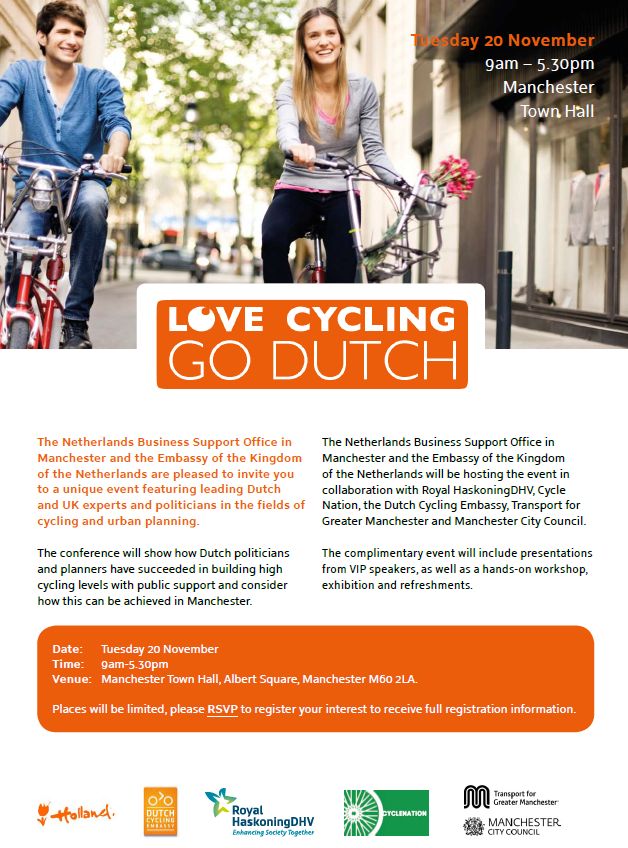
Love Cycling GO Dutch...coming soon to Manchester!


Following the launch of the Manchester Interim Cycling Strategy earlier in the year and subsequent press coverage of Manchester City Council's stated ambition to become the No.1 Cycling City in the UK by 2017 comes the welcome announcement of the Love Cycling GO DUTCH event in Manchester on 20th November.

The meeting, co-sponsored by Netherlands Business Support Office in Manchester and the Embassy of the Kingdom of the Netherlands in London will provide an opportunity for local council officers, transport planners and cycling advocates to meet with leading Dutch and UK experts and policy makers in the fields of cycling and urban planning.

With the recent successful £36+ million Local Sustainable Transport Fund (LSTF) bid and the Cross City Bus Oxford Road Corridor funding -  Manchester has the opportunity to develop more imaginative, consistent, coherent, connected and safe cycling infrastructure.

Time to Go Dutch!


When: 9.00am-5.30pm: Tuesday 20 November 2012
Where: Manchester Town Hall, Albert Square, Manchester, M60 2LA.
A full speaker list will be available soon. Places are limited, so please register your interest

Wednesday, 19 September 2012

What would be the Mancunian version of the Boris Bikes ?

Velib bike hire scheme in Paris.
Back in June, the Manchester Evening News ran a story entitled "Council in bid to make Manchester 'cycle city' with bicycle hire scheme". Despite being a little confused about the difference between Manchester City Council and Transport for Greater Manchester, the article reported that "transport bosses" said that they would "look at possibilities for private funding to roll-out a city-wide scheme, like those in London and Paris."


A bike hire scheme had been mooted in the original Transport Innovation Fund (TIF) bid but since the TIF bid, commonly referred to as the Congestion Charge, was rejected in December 2008 there has been little public discussion of such schemes until the launch of the Brompton Dock scheme at Piccadilly station in March 2012

However, a little electronic birdie delivered an interesting document into this blogs inbox. Entitled 'Terms of Reference: Cycle Hire in Greater Manchester ' the document states that:

"Transport for Greater Manchester (TfGM) is undertaking a study to explore the feasibility of establishing cycle hire schemes for improving sustainable access to key destinations, including employment. Apart from small, local schemes, cycle-hire has not previously been operated in Greater Manchester and this work is being undertaken to understand the role it could potentially fulfil within the wider transport network and the requirements, feasibility, costs and liabilities for setting up and operating a scheme."


The study objectives are to:
  • understand the market for cycle hire in the context of Greater Manchester and advise on its potential.
And if the potential for cycle hire is identified to:
  • identify the options for the development and operation of cycle-hire schemes; and 
  • develop a recommended option for a cycle-hire scheme.
The study is also expected to explore the feasibility of developing and operating cycle-hire in:
  • the wider Regional Centre (Manchester City Centre and parts of neighbouring areas of Salford and Trafford; and 
  • other locations in Greater Manchester.
The study will be undertaken in 2 stages:

Stage 1: Determining the potential market and role for cycle-hire in Greater Manchester.

Stage 2: Subject to the outcome of Stage 1, Stage 2 will develop and recommend detailed proposals.
 

The consultants will be required to produce conclusions on the potential for operating cycle-hire in Greater Manchester - specifically taking into account:

  • Contribution to enhancing sustainable access to key destinations;
  • Key markets and origin-destination movements which would be served;
  • Potential demand and whether this is likely to justify the set-up and operation of a scheme;
  • Types of cycle scheme which may be suitable for operation in Greater Manchester; and
  • Lessons learned from schemes operated in similar locations.

Timescales.

The deadline for consultancy firms to bid for the scoping study is 28th September 2012 and the final report for Stage 1 is 26th November 2012.

It will be very interesting to see what findings the successful applicants come up with.... that is assuming that TfGM make the consultants findings public.   Watch this space......

Friday, 10 August 2012

Making buses work for our cities (TfGM Fringe event at Labour Party Conference)

Making buses work for our cities: Securing seamless and smarter travel for a stronger, greener economy – what Government needs to do.

Date: Monday, 1 October 2012
Time: 1pm – 2pm

Venue: Reception Room, Manchester Town Hall
Refreshments provided

 
Speakers:
  • Lilian Greenwood MP, Shadow Minister for Transport
  • Jonathan Reynolds MP
  • Councillor Andrew Fender, Chair of TfGMC
  • Neil McInroy, Chief Executive, CLES.


For more information about this event please contact Jane Nearny at TFGM Jane.Nearney@tfgm.com


Wednesday, 25 July 2012

Would this booking page encourage you to sign up for adult cycle training?

The subject of adult cycle training often attracts comments such as "everyone can ride a bike" or "if you can't ride a bike by the time your an adult its time to give up". 

Unfortunately, such beliefs are very commonplace. They are also both incorrect. 

Research studies have indicated that between 7-12% of adults in the United Kingdom never learnt to ride a bicycle as a child and many local and transport authorities now recognise the benefits of providing free adult cycle training programmes.

In Manchester the Freewheeling cycle training, delivered by BikeRight! has found that over 25% of the cycle training places have been delivered to people who could not cycle - literally Learn to Ride sessions.  

Even for people who can already ride a bicycle - they are often discouraged from cycling by the volume and speed of the traffic on Greater Manchester roads. There are strong arguments for re-allocating roadspace for cycling and creating a coherent network of off-road, segregated and shared-use cycle routes - and these need to be made to local authorities and Transport for Greater Manchester - but such changes will take time to implement. In the meantime, adult cycle training programmes - such as Freewheeling can help give people the skills and confidence to cycle on the road network. 

Manchester City Council are to be applauded for the support they have provided for adult cycle training since 2010 and cycling advocacy campaigns such as Love Your Bike successfully lobbied for adult cycle training programmes to be included in the Greater Manchester Local Transport Plan (LTP3) - "We will also work with key partners to identify funding and resources to deliver adult cycle training" (page 113) and the Transport for Greater Manchester (TfGM) Local Sustainable Transport Fund bids.

The Department for Transport (DfT) announced in June 2011 that TfGM had successfully been awarded £5million for the Key Component LSTF bid.  The bid document stated that: "A central pool of some 3,330 places will be funded by LSTF funding, to be matched by a similar level of locally funded training."

The bid document also stated that "TfGM will procure a supplier to deliver L3 Bikeability training and bookings will be controlled centrally (following consultation with TfL)." (Emphasis added).

In October 2011, TfGM announced that it had decided to run the adult cycle training 'in-house' and in June 2012 the new TfGM cycling website went live and the cycle training booking form is available here.

Unfortunately, it does not seem that TfGM consulted with TfL regarding the "look and feel" of the booking form as the incredibly long list of Terms and Conditions seem designed to be as off-putting as possible to potential participants.  Here are a couple of my least favourites:

"Clients must have their own bicycle."

"It is a condition that clients present themselves in a fit state, having had proper rest and not under the influence of alcohol or drugs. Clients need to be appropriately dressed for cycling with sturdy shoes."

"The Instructor may at any time refuse to continue to train a client if their ability level is deemed to be unsuitable for the training programme."   

[See bottom of this post for a list of the terms].

Contrast this with the booking form on the Transport for London website, or Leicester Council. Even where some providers - such as Peterborough Travel Choice do have similar terms and conditions they are listed at the end of the booking/consent form - not as the first text that you see!

I have argued for the inclusion of adult cycle training programmes in the Local Transport Plan as well as the LSTF bids and will continue to lobby for local authorities in Greater Manchester to provide adult cycle training programmes after LSTF funds have finished.

I disagree with the choices TfGM have made on how they will deliver the LSTF funded adult cycle training and who they are targeting the training at (those who can already cycle and have a bicycle).  But, they have made their decisions and for now so be it. In the meantime I do wish they would make the booking process a little less off-putting.


Transport for Greater Manchester - Book your training - Terms & Conditions

Please carefully read the following terms and conditions relating to your participation in Transport for Greater Manchester Adult Cycle Training programme.
  • The Adult Cycle Training scheme is administered and delivered by Transport for Greater Manchester. The scheme is run in accordance with national guidelines set by the Department for Transport National Standard for Instructors.
  • The Adult Cycle Training Course is a two hour session and is free. If you are unable to attend the session date allocated to you, you must contact us on 0300 123 1675 immediately so that the Instructor can be notified.
  • Clients must be 16 or over and live or work within Greater Manchester.
  • Clients must have their own bicycle.
  • Clients may only book / rearrange a session on a maximum of 3 occasions.
  • It is a condition that clients present themselves in a fit state, having had proper rest and not under the influence of alcohol or drugs. Clients need to be appropriately dressed for cycling with sturdy shoes.
  • Clients must ensure that the Instructor is aware of any medical condition they have which may affect the training.
  • Clients who need to wear glasses / contact lenses must ensure they bring them to the session.
  • Every effort will be made to accommodate any special requirements clients may have provided they have notified us. If no indication has been made we cannot be held responsible should a client be unable to complete the session.
  • It is the Client's responsibility to ensure that their bicycle is roadworthy before attending the training session.
  • The Instructor may refuse to train Client's if their bicycle is not roadworthy. The Instructor's decision is final.
  • Instructors working on behalf of Transport for Greater Manchester are not obliged to carry out repairs to make an un-roadworthy bicycle roadworthy.
  • The Instructor may at any time refuse to continue to train a client if their ability level is deemed to be unsuitable for the training programme.
  • Transport for Greater Manchester requires clients to be respectful and professional to our Instructors, staff and other attendees or participants whilst taking part in the Adult Cycle Training programme.
  • Transport for Greater Manchester reserves the right to terminate the training or ask a client to leave should they be deemed rude, uncooperative, unprofessional, intoxicated or in possession of alcohol or any illegal substance. In such cases of unsuitable behaviour, clients will be excluded from any future training session.
  • Transport for Greater Manchester is not responsible for any injury, loss or damage to any property.
  • Clients are advised that to become proficient takes much more practice than a training session of this kind can provide.
  • Clients are responsible for the decision to wear a helmet during a training session. If a helmet is worn it is must fit properly.
  • Clients must ensure they wear suitable clothing for the training session and prevailing weather conditions expected during their session. Clients must accept the Terms and Conditions before a training session commences and that a training session cannot take place if these terms and conditions are not agreed too.
  • In the unlikely event we are unable to deliver a training session due to reasons beyond our control; we will reschedule your session as soon as possible. Please contact Transport for Greater Manchester us if you are unhappy with any aspect of your training session.
  • Transport for Greater Manchester (TfGM) and its service providers will use your personal information for the purposes of customer services and administration, customer research and fraud prevention.
  • We may contact you to ask for feedback regarding the training session.
  • Under the Data Protection Act your details will not be shared with or passed onto any other organisation. You may request details of personal information which we hold about you under the Data Protection Act 1998. If you believe that any information we are holding about you is incorrect or incomplete, please contact us as soon as possible. We will promptly correct any information found to be incorrect.


Saturday, 24 March 2012

Budget? What Budget !

The Cities Fit for Cycling campaign, recently launched by the Times newspaper, has helped focus political attention on the need to improve the environment for cycling in the UK.  The campaign lists 8 'manifesto' demands and one of these highlights the need for UK cities to show clear political support and leadership on cycling issues, namely:

"Every city, even those without an elected mayor, should appoint a cycling commissioner to push home reforms." ('Manifesto pt.8).


Since 1st April 2011, the newly established Transport for Greater Manchester (TfGM) has had the strategic responsibility for developing and implementing policies to support, encourage and increase the levels of walking and cycling (active travel) across Greater Manchester.

The policy document that sets out the transport vision for Greater Manchester is known as Local Transport Plan (LTP3), which unsurprisingly follows on from LTP1 and LTP2 and runs from 2011 to 2016. The LTP3 document contains some positive policy statements about the importance of increasing the levels of cycling and walking to help:

Improve access to work:"There are further opportunities for increasing cycling to work, particularly by improving the environment for cyclists along key routes to major employment destinations, such as The Corridor, Manchester City Centre and the other major town centres, by re-routing general traffic, reallocating road space to buses and cyclists and investing in cycle infrastructure and parking." (Page 30).

Improve health:  "For shorter journeys, or for access to the public transport network, we recognise the huge potential of walking and cycling in providing a low cost, healthy travel option." (Page 48).

"Like walking, cycling has great potential to improve public health. The overall aim will be to enable people to cycle safely throughout the on and off-road network. However, we recognise the need to focus our investment where it is likely to achieve the greatest impact, informed by our analysis of local travel markets. Our policies will help to create a pro-cycling culture by providing safer cycle routes; more parking and training; and traffic management that reduces speeds and gives greater priority to cyclists. In particular, we see great value in prioritising cycle access to Manchester City Centre, town centres and public transport interchanges, supported by improved cycle parking at these locations." (Page 52, Priority: A network of safe cycle routes in support of greatly increased levels of cycling across Greater Manchester).


Reduce CO2 emissions: "In promoting “smarter choices”, this Plan recognises the need to encourage a shift from singleoccupancy car use to walking, cycling, public transport and car sharing. Our proposals set out ways to improve the pedestrian environment, remove barriers to cycling, improve cycling infrastructure, enhance the coverage and quality of public transport, and manage the highway network. This will help to encourage more car users to change the way they travel, and also make it easier for people who do not have access to a car to travel to key facilities." (Page 50, Priority: Delivery of lower carbon travel options).


Which all sounds great, but lets get back to that issue of leadership.  Despite having strategic responsibility for active travel (walking and cycling), the Terms of Reference for the TfGM Committee (a committee of 33 councillors from all 10 GM local authorities that is responsible for the oversight and scrutiny of TfGM policy, operations and expenditure) does not include any specific reference to active travel (walking and cycling). 

On 31st March 2011, Manchester Friends of the Earth wrote to the TfGM committee raising concerns about how this could make clear oversight and leadership more difficult. The letter argued that:

"for Greater Manchester to meet the active travel and sustainable transport policy objectives outlined in the Local Transport Plan (LTP3), the TfGMC Terms of Reference should clearly define the leadership, oversight and scrutiny mechanisms in relation to active travel policy development and service delivery of measures aimed at increasing walking and cycling levels in Greater Manchester."

The response stated:

..."the recently GMCA approved Third Local Transport Plan (LTP 3), which sets the overall transport strategy for Greater Manchester, has a whole Chapter outlining the agreed approach to Active Travel.  This is explicit in stating that ‘Active Travel will have a central role in the LTP strategy;’ thus given all TfGMC’s functions need to be exercised in accordance with the agreed policies and budgets of the GMCA and its Local Transport Plan, there will plainly be a role for TfGMC in this regard, alongside that of the highway authorities.  

This role however is one primarily of oversight, co-ordination and monitoring TfGM in its activities in implementing LTP objectives, rather than TfGMC becoming involved in the detail of any particular Active Travel scheme, and TfGMC members have been advised accordingly.  Specifically, it is set out in the Operating Agreement and the Constitution whereby TfGMC is to ensure that TfGM implements those actions delegated to it for promoting the economic, social and environmental well-being of Greater Manchester and its residents pursuant to Section 99 of the Local Transport Act 2008.  This role will extend beyond just the LTP, for example to overseeing TfGM in the LSTF bid and implementation process." 

Which basically means that as Transport for Greater Manchester (TfGM) officers are responsible for delivery of the Active Travel objectives, as outlined in LTP3, the TfGM Committee will be able to provide sufficient oversight by monitoring the reports from Officers on the progress of LTP3.

Manchester Friends of the Earth disagreed and recommended that:

"the Terms of Reference identify a TfGMC Committee Chair, or other appropriate board member, with specific responsibility for reporting on active travel (cycling and walking) policy development and progress of any subsequent active travel service delivery measures. "

Showing leadership means, amongst other things, taking responsibility and being open & transparent about who has that responsibility and what they have (or haven't) done.  Currently, it is not at all clear that the TfGM Committee is demonstrating clear leadership on Active Travel (cycling and walking) issues.

For example, at the recent TfGM Committee meeting, the £237 million TfGM budget was discussed (*). However, it is not clear how TFGM Committee members can provide effective oversight and scrutiny of Active Travel (cycling and walking) policies and developments when the Budget does not contain a single mention of the terms "cycling", "walking", "Active Travel", "Smarter Choices" or "sustainable".


Action: If you think it might be useful for the TfGM Committee to show a little more leadership on cycling issues across Greater Manchester, why not write a (polite) email to Andrew Fender (email), the Committee Chair and/or the Councillors from your local authority who represent you on the TfGM committee highlighting your concerns.

We look forward to next year's budget with unabated enthusiasm......


(*) The term "discussed" is used in its loosest possible sense as the budget item was concluded within approximately 60 seconds, with not a single question, comment or objection raised by any of the Councillors present.

Wednesday, 29 February 2012

Public Service Announcement #5

This just in from Transport for Greater Manchester (TfGM)....


Dear All,

I thought that some of your contacts would be interested in the free cycle check sessions being arranged during March. Please feel free to forward the information below to anyone who may be interested.

Transport for Greater Manchester is running drop-in sessions across Greater Manchester over the next few Saturdays to give your bike a helpful once-over.

Our experts will give your bike a health-check, including brakes, tyres, frame, steering, gears and chain. It’s not a service or an MOT for your bike but our technicians can make small adjustments on the spot, and give you a diagnosis for anything that needs a repair.

Thanks to Greater Manchester Fire and Rescue Service we’ve been able to line up a series of sessions at fire stations around the area, so there should be one near you (please see the list below).

Just bring your bike between 10am – noon and 1pm – 3pm to the fire station below that best suits you.

Our free cycle checks are part of the TfGM commuter cycle programme, wholly funded by the Department for Transport.

For more details please check get in touch with the team on 0161 244 1264 or cycle@tfgm.com or visit www.tfgm.com/cycle .

Kind Regards

Tony Short
Project Support Officer
LSTF – Commuter Cycling Project
Transport for Greater Manchester
Tony.Short@tfgm.com

Bolton
3 March – Moor Lane, Bolton BL3 5DB
10 March – Crompton Way, Bolton BL1 8UP
17 March – Albert Road, Farnworth, Bolton BL4 9HF

Bury
3 March – The Rock, Bury BL9 5AH
10 March – Bury New Road, Whitefield M45 7SY

Manchester
3 March – Denhill Road, Manchester M15 5NR
10 March – Thompson Street, New Cross, Manchester M4 5FP
17 March – Rochdale Road, Blackley, Manchester M9 7EQ
17 March – Birch Street, West Gorton, Manchester M12 5NS
17 March – Wilmslow Road, Withington, Manchester M20 4AW
24 March –Brownley Road, Wythenshawe, Manchester M22 5FG
24-March – Philips Park, Briscoe Lane, Manchester M40 2XG

Oldham
3 March – Lees Road, Oldham OL4 1JN
10 March – Broadway, Chadderton OL9 0JX
24 March – Hollins Road, Hollins OL8 3BD
               
Rochdale
3 March – Maclure Road, Rochdale OL11 1DN
10 March – Middleton Road, Heywood OL10 2LU

Salford
3 March – Liverpool Street, Salford M5 4LE
10 March – Bury New Road, Broughton, M7 4LE
17 March – Bolton Road, Pendlebury M27 8XS
24 March – Liverpool Road, Eccles M30 0RZ
               
Stockport
3 March – Whitehill Street West, Stockport SK4 1NR
10 March – King Street West, Stockport, Cheshire SK3 0DT
17 March – Turves Road, Cheadle Hulme, Cheshire SK8 6AY
24 March – Lisburn Lane, Stockport SK2 5NP
               
Tameside
3 March – Slate Lane, Off Ashton Moss Way, Audenshaw M34 5FS
10 March – Ramsbottom Street, Stalybridge SK15 1RF
17 March – Railway Street, Hyde SK14 1DF
               
Trafford
3 March – Park Road, Stretford, Manchester M32 8RJ
10 March – Cranleigh Drive, Sale, Manchester M33 7NT
17 March – 43 Manchester Road, Broadheath, Altrincham WA14 4RQ
               
Wigan
3 March – Robin Park Road, Newtown, Wigan WN5 0UU
10 March – Gloucester Street, Atherton M46 0JT
17 March – St Helens Road, Leigh WN7 3PA