Monday, 8 October 2012

Bikes on trains....


Compared to most public transport services, Northern Rail are more progressive in facilitating people to be able to travel on the train with their bicycles.

Northern's website states that the company is "strongly committed to promoting cycling. It is a sustainable and healthy form of transport and complements our train services. It is a key part of our integrated transport approach which is supported by our parent companies Serco and Abellio."

The company's 2010 cycling strategy document recognises some of the peak hour problems:

"Many of our trains consist of only two (or in some cases one) carriages. This can present serious difficulties in accommodating more than two bikes per train unit. In addition, our passenger numbers are growing by about 10% pa, so more trains are crowded. We wish to maintain our current flexible approach which avoids specific bans on rush hour trains and allows bikes to be carried free of charge."

More positively, the cycling strategy committed Northern Rail to the following actions in 2010/11.

"• Ensure that staff, particularly conductors, are fully briefed on Northern’s cycle policy
• Maintain our policy of not charging
• Maintain our policy of no formal peak restrictions
• Maintain our policy of ‘no advance reservations’
• When trains are refurbished we will explore opportunities for improving cycle space, on
the principle of providing flexible space
• Ensure that all the Northern fleet is signed externally and internally showing where bike
space is located
• In any future programme for new designs (e.g. Pacer replacement) we will ensure that
flexible space is maximised."


Unsurprisingly, they are also encouraging people to travel with folding bicycles.

"This is a growing market and we are happy to work with cycling organisations to encourage the use of folding bikes for cycle commuting. They take up minimal space and there are no restrictions on the number carried per train."


Northern Rail are looking to update their Cycling Strategy and the Northern Rail Cycle Forum have requested suggestions for both short and longer term objectives.


If you have any constructive suggestions, please send them to Les Webb, secretary for the  Northern Rail Cycle Forum at   les.webb at sustrans.org.uk  by the end of October.

Perhaps Metrolink would like to talk to their Northern Rail counterparts about how to integrate bicycles into a busy public transport service.....

Thursday, 4 October 2012

20’s Plenty is green


It’s a popular misconception that fuel efficiency peaks at 50-60mph. However, What Car magazine found that for many cars 20mph was the most efficient speed.  In urban conditions 20mph beats 30mph for saving fuel. 20mph limits mean less acceleration and braking. Walking and cycling increase. 


Britain suffers from excessive speeds and volumes of motorised traffic, which affects our environment, climate and health. Traffic brings pollution, congestion, noise and degrades the built environment. Road transport contributes one-fifth of the UK's total emissions of carbon dioxide (CO2), the main greenhouse gas. Road transport CO2 increased nearly 23% between 1990 and 2010. Transport is the only sector where greenhouse gas emissions are rising.

When 30km/h (18.6mph) zones were introduced in Germany, car drivers changed gear 12% less often, braked 14% less often and required 12% less fuel. This implies 20mph limits without humps can cut residential transport emissions by 12%. Traffic smoothes, gaps between cars shorten, it’s easier to merge and there’s less idling with dangerously concentrated pollutants. Limits either speed up trip times due to smoother traffic, or do not significantly affect times from origin to destination. 

Some people are afraid to walk or cycle.  20mph limits improve fairness in sharing the public space of roads between vulnerable users and traffic. Bristol found 20mph increased walking 23% and cycling 20.5%. Traffic reduction could cut another 5-10% of fuel use.  This all helps drivers to save money, reduce pollution and conserve our dwindling reserves of liquid fuels like oil and diesel.

With 20mph limits it’s easier and safer to reach local amenities. This helps keep nearby shops viable - with important accessibility and mixed use planning benefits.  20mph supports local facilities and jobs in the face of competition from edge of town developments or e-shopping. Those without a car, the elderly, disabled, families or on foot or cycling are more likely to frequent and enjoy local and convenience stores for longer, strengthening their community and making their lives more sustainable and resilient.

20mph is up to 40% quieter than 30mph, making urban areas more pleasant. People can more easily talk and play outside which raises health and neighbourliness and reduces crime. An additional eco benefit includes less need for road signage lighting as this is not required on many warning signs in a 20mph limit.

Environmental groups supporting wide 20mph limits include: Friends of the Earth; CPRE; Campaign for Better Transport; The Conservation Volunteers; Environmental Protection UK; Chartered Institute of Environmental Health; CTC the national cyclists’ organisation; Environmental Association for Universities and Colleges; Ramblers’ Association; Sustainable Development Commission; ETA Trust; Transform Scotland; Sustrans; Living Streets; The Liberal Democrat and Green Parties; Stockholm Environment Institute and more.

A 20’s Plenty for Us Briefing, October 2012.


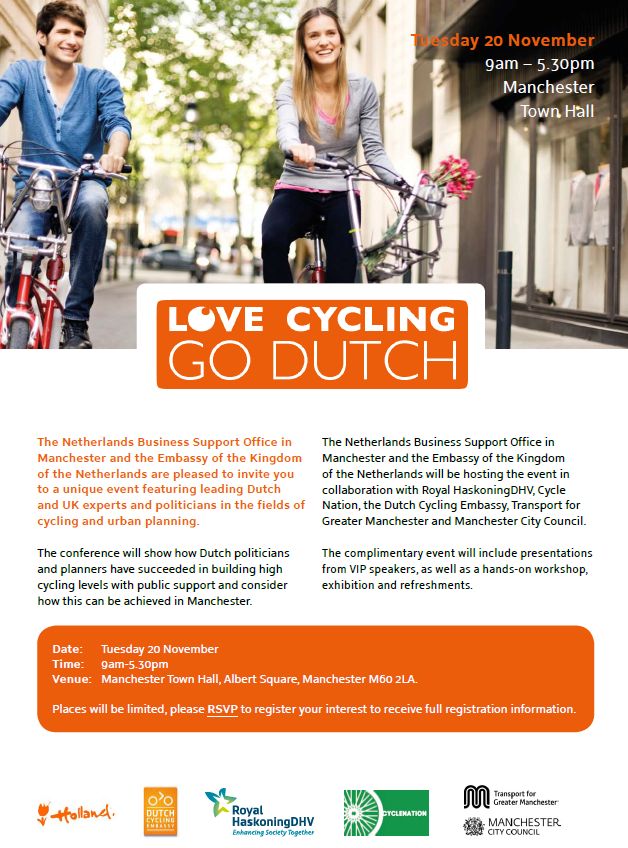
Love Cycling GO Dutch...coming soon to Manchester!


Following the launch of the Manchester Interim Cycling Strategy earlier in the year and subsequent press coverage of Manchester City Council's stated ambition to become the No.1 Cycling City in the UK by 2017 comes the welcome announcement of the Love Cycling GO DUTCH event in Manchester on 20th November.

The meeting, co-sponsored by Netherlands Business Support Office in Manchester and the Embassy of the Kingdom of the Netherlands in London will provide an opportunity for local council officers, transport planners and cycling advocates to meet with leading Dutch and UK experts and policy makers in the fields of cycling and urban planning.

With the recent successful £36+ million Local Sustainable Transport Fund (LSTF) bid and the Cross City Bus Oxford Road Corridor funding -  Manchester has the opportunity to develop more imaginative, consistent, coherent, connected and safe cycling infrastructure.

Time to Go Dutch!


When: 9.00am-5.30pm: Tuesday 20 November 2012
Where: Manchester Town Hall, Albert Square, Manchester, M60 2LA.
A full speaker list will be available soon. Places are limited, so please register your interest

Those boots were made for walking...October is Walk to School month


October is International Walk to School Month. 

Each October, primary school children from across the UK join forces with over 40 countries worldwide to celebrate the benefits of walking to school.

Walk to School Month in the UK is run by Living Streets. In 2012, we’ll be celebrating with Strider’s International Walking Challenge. This month-long activity encourages pupils to walk at least once a week for the month. We provide classroom packs that include everything a school needs to run a month-long challenge, encouraging pupils to walk. 

This Walk to School Month, Living Streets is delighted to be teaming up with children’s shoe manufacturer Start-rite to encourage more children to walk to school during International Walk to School Month. 

Start-rite are sponsoring 20 schools in the Greater Manchester area to take part in Living Streets’ WoW (Walk once a Week) scheme which awards badges as incentives for children to walk to school regularly. 

More details on Living Streets' Walk to School Month website


Sunday, 23 September 2012

Criminal Justice system 'failing' to protect people who cycle...

Last week the Manchester Evening News reported that hundreds of people had been fined as Greater Manchester police launched a  "crackdown on pavement cyclists". The article went on to question whether it was a good use of public resources to fine or prosecute people who may well be cycling on the pavements as they do not feel safe cycling on the roads because of the speed and volume of the road traffic.

Only a day later, the cycling website Road.CC ran a story highlighting how a school caretaker in Hull who "deliberately ran down a cyclist in a fit of rage walked away from court with a £350 fine."

It was reported that the caretaker, Cal Groves, 45, shouted abuse at Gerard Lumb before knocking him over and driving off. The driver convicted of 'careless driving' and given nine points on his licence

Perhaps the caretaker was friends with the new Transport Minister, Simon Burns, who was convicted in 2009 of careless driving in an incident which left a cyclist with a broken neck. Road.cc reported how the Conservative MP had told the police that the "coast was clear as he drove out of Houses of Parliament - CCTV evidence proved otherwise".

A previous blog, in January 2011, Cyclists 'left unprotected by police and courts' highlighted a fascinating paper by Jake Voelcker entitled "A Critical Review of the Legal Penalties for Drivers Who Kill Cyclists of Pedestrians" takes as its starting point a CTC news comment:"


The review provides a fascinating and clear, if depressing, picture of how poorly the legal system responds to cases where drivers have killed, or seriously injured, cyclists.

Amongst many interesting comparisons the review highlights how the
"Health and Safety regulations would not permit thousands of one-tonne steel and glass machines with exposed moving parts to repeatedly pass feet or inches away from unprotected workers on the shop floor at well over 10m/s (HSE 1998, Sect.11). Yet this is the situation in our towns and cities today. Why are drivers allowed to impose this danger on pedestrians without more strict prosecution of liability?"


Two cycling organisations, the CTC and British Cycling, have joined together to ask MPs to support an early day motion (EDM) that is demanding a review of the criminal justice system for those injured on the roads.


The Early Day Motion 407 "Victims of Road Accidents" notes: "That this House notes that many victims of road accidents do not feel that the criminal justice system adequately protects or supports them in the aftermath of their case; further notes that it is important that those who have suffered traumatic incidents are given effective and sympathetic support as they attempt to rebuild their lives; welcomes the work of British Cycling and other groups, including CTC, Sustrans, London Cycling Campaign, The Times, Cycling Weekly, RoadPeace and Brake to raise the profile of the issue; and calls on the Ministry of Justice to review carefully the evidence they have submitted and undertake a comprehensive review of each part of the criminal justice system, from crash investigation standards through to sentencing guidelines, to ensure that it is fairer for cyclists, pedestrians and other road users who are hurt or seriously injured on the country's roads."

The following Greater Manchester MPs have already supported the Early Day Motion (407).

Bolton North East: David Crausby
Heywood and Middleton: Jim Dobbin
Manchester Withington: John Leech


As of the 22nd September, the following Members of Parliament had not signed up.  Why not drop them a quick email asking them to support the Early Day Motion and get a review of the way the criminal justice system treats people who cycle.

Altrincham and Sale West: Graham Brady MP.   Email   crowthers@parliament.uk

Ashton-Under-Lyne: David Heyes MP.                  Email    heyesd@parliament.uk
Bolton South East: Yasmin Qureshi MP.               Email   yasmin.qureshi.mp@parliament.uk
Bolton West: Julie Hilling MP.                                Email   julie.hilling.mp@parliament.uk
Bury North: David Nuttall MP.                                Email  david.nuttall.mp@parliament.uk 
Bury South: Ivan Lewis MP.                                   Email  ivanlewis@burysouth.fsnet.co.uk
Cheadle: Mark Hunter MP.                                    Email mark.hunter.mp@parliament.uk
Denton and Reddish: Andrew Gwynne MP          Email  gwynnea@parliament.uk
Leigh: Andy Burnham MP                                     Email  burnhama@parliament.uk
Manchester Blackley: Graham Stringer MP         Email  stringerg@parliament.uk
Manchester Central: Tony Lloyd MP                      Email  contact@tonylloydmp.co.uk
Manchester Gorton: Gerald Kaufman MP            Email   kaufmang@parliament.uk
Makerfield: Yvonne Fovargue MP                          Email  yvonne.fovargue.mp@parliament.uk
Oldham East and Saddleworth: Debbie Abrahams MP   debbie.abrahams.mp@parliament.uk
Oldham West and; Royton: Michael Meacher MP Email  massonm@parliament.uk
Rochdale: Simon Danczuk MP                               Email  simon.danczuk.mp@parliament.uk
Salford: Hazel Blears MP                                        Email  blearsh@parliament.uk
Stalybridge and Hyde: Jonathan Reynolds MP     Email  jonathan.reynolds.mp@parliament.uk
Stockport: Andrew Stunell MP                                Email  enquiries@andrewstunell.org.uk
Stockport: Ann Coffey MP                                       Email   coffeya@parliament.uk
Stretford and Urmston: Kate Green MP                 Email   kate.green.mp@parliament.uk 
Wigan: Lisa Nandy MP                                            Email  lisa.nandy.mp@parliament.uk
Worsley: Barbara Keeley MP                                 Email  keeleyb@parliament.uk
Wythenshaw and Sale: Paul Goggins MP             Email  gogginsp@parliament.uk

If you don't know who your Member of Parliament is - plunk your postcode into the Write to Them website....


Meanwhile, here's a suggestion for Greater Manchester Police, instead of prosecuting and fining people for cycling on the pavement - who may be wary of cycling on the road because of traffic speed and lack of confidence - why not follow Merseyside police and give people postcards advertising the free adult cycle training available for people in Manchester.  See here for details.

Friday, 21 September 2012

West Yorkshire 1.... Greater Manchester 0

A blog earlier this week highlighted the lack of activity in Greater Manchester for European Mobility Week.

Contrast this with the Free Metrocard campaign from the West Yorkshire Travel Plan Network.


Which makes a simple offer:


Free monthly MetroCards

If you use the car to get to work you could now benefit from a free monthly MetroCard.

These tickets are valid on all buses and trains in West Yorkshire, and are available to staff who normally drive to work, and are willing to leave the car at home for their commute to work. The tickets will be valid for the whole of October 2012.

If you would like to take part apply now for a free monthly MetroCard


If we were watching a football match - perhaps the chant would be "Are you watching.... Manchester."

Wednesday, 19 September 2012

What would be the Mancunian version of the Boris Bikes ?

Velib bike hire scheme in Paris.
Back in June, the Manchester Evening News ran a story entitled "Council in bid to make Manchester 'cycle city' with bicycle hire scheme". Despite being a little confused about the difference between Manchester City Council and Transport for Greater Manchester, the article reported that "transport bosses" said that they would "look at possibilities for private funding to roll-out a city-wide scheme, like those in London and Paris."


A bike hire scheme had been mooted in the original Transport Innovation Fund (TIF) bid but since the TIF bid, commonly referred to as the Congestion Charge, was rejected in December 2008 there has been little public discussion of such schemes until the launch of the Brompton Dock scheme at Piccadilly station in March 2012

However, a little electronic birdie delivered an interesting document into this blogs inbox. Entitled 'Terms of Reference: Cycle Hire in Greater Manchester ' the document states that:

"Transport for Greater Manchester (TfGM) is undertaking a study to explore the feasibility of establishing cycle hire schemes for improving sustainable access to key destinations, including employment. Apart from small, local schemes, cycle-hire has not previously been operated in Greater Manchester and this work is being undertaken to understand the role it could potentially fulfil within the wider transport network and the requirements, feasibility, costs and liabilities for setting up and operating a scheme."


The study objectives are to:
  • understand the market for cycle hire in the context of Greater Manchester and advise on its potential.
And if the potential for cycle hire is identified to:
  • identify the options for the development and operation of cycle-hire schemes; and 
  • develop a recommended option for a cycle-hire scheme.
The study is also expected to explore the feasibility of developing and operating cycle-hire in:
  • the wider Regional Centre (Manchester City Centre and parts of neighbouring areas of Salford and Trafford; and 
  • other locations in Greater Manchester.
The study will be undertaken in 2 stages:

Stage 1: Determining the potential market and role for cycle-hire in Greater Manchester.

Stage 2: Subject to the outcome of Stage 1, Stage 2 will develop and recommend detailed proposals.
 

The consultants will be required to produce conclusions on the potential for operating cycle-hire in Greater Manchester - specifically taking into account:

  • Contribution to enhancing sustainable access to key destinations;
  • Key markets and origin-destination movements which would be served;
  • Potential demand and whether this is likely to justify the set-up and operation of a scheme;
  • Types of cycle scheme which may be suitable for operation in Greater Manchester; and
  • Lessons learned from schemes operated in similar locations.

Timescales.

The deadline for consultancy firms to bid for the scoping study is 28th September 2012 and the final report for Stage 1 is 26th November 2012.

It will be very interesting to see what findings the successful applicants come up with.... that is assuming that TfGM make the consultants findings public.   Watch this space......